

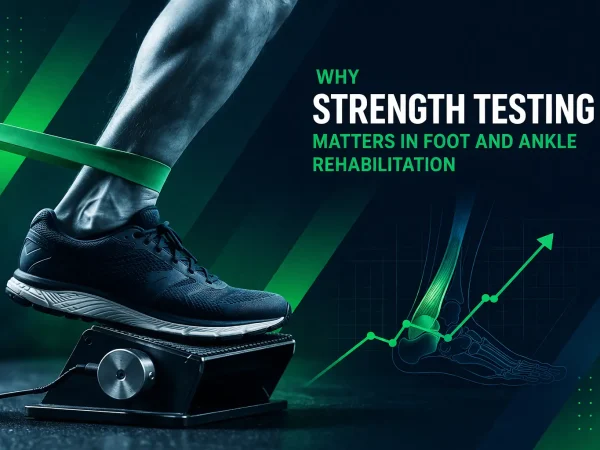
Why Strength Testing Matters in Foot and Ankle Rehabilitation
When someone has foot or ankle pain, most attention goes to the painful area.
That is understandable.
If your heel hurts, your Achilles feels overloaded, your ankle still feels weak after a sprain, or your foot does not feel right when you run, it is natural to focus on the sore bit and ask how to calm it down.
But that is only part of the picture.
Pain tells you where the problem is showing up. It does not always tell you why it is still there.
That is where strength testing becomes useful.
Because in foot and ankle rehabilitation, one of the most important questions is not just, “Does it hurt?”
It is:
How well is the system actually working?
And more specifically:
Does the foot, ankle and lower limb have enough strength to cope with the load you are asking it to manage?
That is the real reason strength testing matters.
It gives you something more useful than guesswork
The original article makes a simple but important point. Strength testing helps clinicians assess muscle function, track recovery progress and guide treatment plans using objective measures such as dynamometers and force plates.
That matters because a lot of rehab can otherwise drift into educated guesswork.
A person says they feel a bit better.
The swelling has gone down.
They can walk more comfortably.
They think they are ready to progress.
That may all be true.
But it does not necessarily mean strength has returned to a level that is actually useful for walking, running, jumping, turning or returning to sport.
And that is where problems often come back.
Not because the person did anything wrong, but because symptoms improved faster than physical capacity.
Strength testing helps close that gap.
It helps identify what is still underperforming
One of the clearest benefits of strength testing is that it helps identify muscle weakness and imbalance, particularly after injury or surgery, when compensatory movement patterns are common.
That is hugely important in real life.
If someone has had an ankle sprain, for example, they may feel “fine” in general after a few weeks. But that does not mean the ankle stabilisers are back to where they need to be. The calf may still be underperforming. Push-off may still be reduced. One side may still be weaker than the other. Their confidence may return before their true capacity.
Without testing, that can be missed.
And when it is missed, people often return to activity with a body that is coping, but not properly ready.
Symptoms are only one part of recovery
This is probably one of the most important ideas in rehab.
Pain reduction is good. Of course it is.
But pain reduction is not the same as full recovery.
The article highlights that regular strength assessments provide measurable data on improvement over time and help clinicians adjust the rehab plan accordingly.
That is useful because it gives recovery some structure.
Instead of relying only on how things feel day to day, you can also look at:
- how much force is being produced
- whether one side is still weaker
- whether the person is improving
- whether they are actually ready to progress
This makes rehab far more precise.
It helps reduce the risk of re-injury
This is where strength testing becomes more than just “interesting data.”
The original article states that weak foot and ankle muscles increase the risk of instability and future injuries, and that testing helps confirm whether recovery is sufficient before returning to sport or normal activity.
That is a big deal.
Because a lot of recurring injuries happen when someone returns too soon, not necessarily because they were reckless, but because their body was not ready for the level of force being placed through it.
That is especially true in:
- running
- field sports
- court sports
- jumping and landing sports
- any activity involving repeated push-off, balance and change of direction
If the system is still weak, unstable, or asymmetrical, the same weak point often reappears.
It helps guide treatment, not just confirm weakness
This is another area where good assessment makes a difference.
Strength testing is not only there to tell you what is wrong. It is there to shape what happens next.
The source article says that strength testing helps clinicians individualise rehabilitation plans and decide when it is appropriate to progress to weight-bearing exercise, balance work, or sport-specific drills.
That is exactly how it should be used.
If testing shows the calf is still underperforming, the rehab focus changes.
If ankle inversion or eversion strength is lagging, that matters.
If the foot’s intrinsic muscles aren’t doing enough, that changes the plan.
If someone looks comfortable walking but is still clearly weak in single-leg control, there is work still to do.
This is what separates a structured rehab process from a generic set of exercises.
Athletes are not the only people who benefit
Although the article specifically notes the value of strength testing for runners, dancers and athletes who rely on foot and ankle stability, the principle applies much more widely.
You do not need to be a competitive athlete for strength deficits to matter.
You just need to ask your body to do something it currently cannot tolerate well.
That could be:
- getting back to running
- walking longer distances
- returning to the gym
- coping with work on your feet
- rebuilding after surgery
- recovering from repeated ankle sprains
- managing load after Achilles or plantar heel pain
The point is not whether you are an athlete.
The point is whether strength is limiting your recovery.
Good rehab should be progressive, not random
The article also includes examples of strengthening and control exercises, such as big toe flexion, resistance-band ankle work, calf raises, intrinsic foot exercises, balance drills, and plyometric progressions, all intended to build force production, stability, and neuromuscular control.
Those examples are helpful, but the bigger lesson is this:
Exercises are only as good as the reason for choosing them.
There is no shortage of ankle rehab exercises online. The problem is that many people are doing movements without knowing whether those exercises match the actual deficit.
That is why testing matters.
It gives context.
Instead of doing a random mix of band work, calf raises and balance drills and hoping for the best, you can target the part of the system that really needs improving.
It also gives people confidence
Objective testing does not just help clinicians. It helps the person doing the rehab.
Why?
Because it gives them something solid to work from.
They are no longer relying only on:
- “I think it feels a bit stronger”
- “It seems better this week”
- “I hope I’m ready”
They can see progress more clearly.
That can make a big difference to confidence, especially if someone has had a stop-start recovery, repeated setbacks or a previous injury that never felt fully resolved.
Final thought
Strength testing matters in foot and ankle rehabilitation because recovery is not just about pain settling down.
It is about making sure the system is strong enough, stable enough and prepared enough for what comes next.
Without that, people often return to activity with a foot or ankle that feels better but is still not truly ready.
With proper testing, rehab becomes clearer, more measurable and more purposeful.
And that usually leads to better decisions.
Next step
If you are recovering from foot or ankle pain and want to know whether things are actually getting stronger rather than just feeling slightly better, the best next step is to book an appointment or speak with the clinic.
A proper assessment can help show what is improving, what is still lagging behind, and what needs to happen next.