

Why Muscle Strength Matters More Than Most People Realise in Foot Pain
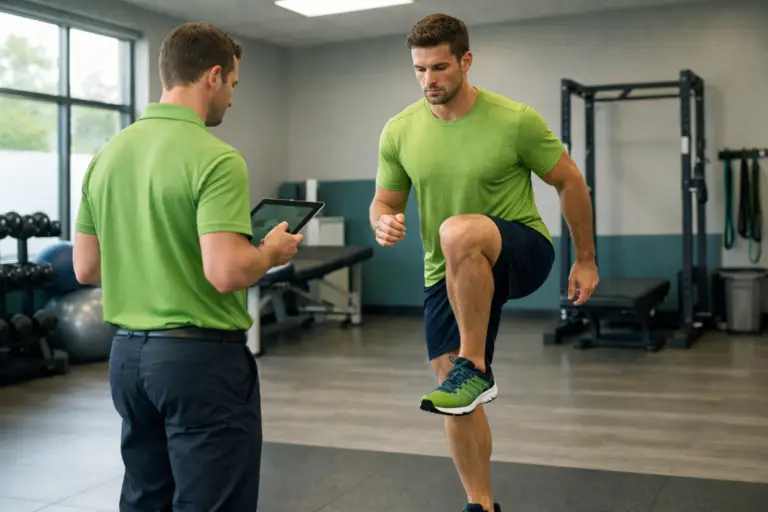
When people have foot pain, they usually look straight at their feet.
That makes sense.
If your heel hurts, your arch aches, your forefoot feels overloaded, or your Achilles is grumbling every time you train, it is natural to assume the problem must be sitting right there in the painful area.
Sometimes it is.
But not always.
A lot of foot pain is not just about what is happening in the foot. It is about what the rest of the leg is doing well enough, or not. The original article you shared makes this exact point, arguing that the ankle-foot complex does not function in isolation and that hip, thigh and ankle strength all influence foot biomechanics and loading.
That is where people often get stuck.
They treat the sore bit.
They stretch what feels tight.
They maybe change shoes.
They might even get some temporary relief.
Then the same pain comes back.
That is usually when the better question appears:
Is this really a foot problem, or is my foot taking the strain for something else further up the chain?
The foot is the end of the line, not the whole story
Your foot deals with the ground, but it does not work alone.
Every time you walk, run, lunge, jump or change direction, force travels through the entire lower limb. The hip, thigh, knee, calf and ankle all influence how that load reaches the foot and how efficiently it is absorbed. The source article describes this as a kinetic chain interaction, with the hip and thigh muscles affecting lower-limb alignment, stability, and force distribution to the ankle and foot.
If those upstream muscles are doing their job well, the foot is part of a strong system.
If they are not, the foot often ends up carrying more than its fair share.
That is why two people can have the same diagnosis on paper and completely different reasons for why it developed.
Why this matters in real life
This is not just a theory for academic articles.
It shows up in the clinic all the time.
You see someone with plantar heel pain. They have tried stretching the calf, rolling the foot, and changing shoes. It helps a bit, then stalls.
Or someone has Achilles pain that keeps settling and then returning the moment running volume increases.
Or someone has forefoot pain that feels worse the harder they train, even though nothing dramatic has happened.
In all of those situations, local treatment may help. But if the lower limb is not controlling the load properly, the painful area often ends up paying the price.
That is why muscle strength matters.
Not because strength is trendy.
Because strength changes how the load is handled.
The hip matters more than most people expect
A lot of people are surprised by how often hip strength comes up in a foot pain conversation.
But if the hip is not controlling the leg well, the foot often has to deal with the consequences.
The article you shared highlights the role of the hip abductors and external rotators in controlling pelvic stability and limiting excessive femoral internal rotation, both of which influence foot pronation and force transfer. It also notes that weak hip muscles may contribute to overload patterns linked with plantar fasciitis and posterior tibial tendon problems.
That does not mean every sore foot is caused by weak glutes.
It does mean that if the leg collapses inward, the knee drifts poorly, or the hip cannot stabilise well enough under load, the foot often becomes the part that complains first.
The thigh and knee are part of the same conversation
This is one thing people usually understand more quickly.
If the calf complex is not strong enough, especially through plantar flexion, push-off becomes less efficient and loading through the foot changes.
The source article explains that the plantar flexors help generate push-off force and control landing, and that deficits in these muscles can increase force transmission into the forefoot. It also points to evidence that people with Achilles tendinopathy often show weaker plantar flexors when measured objectively.
That matters because many active people think calf strength is only relevant to runners.
It is not.
If you walk a lot, play sports, train in the gym, play padel, play golf, or spend long periods on your feet, calf capacity matters.
A lot.
It is not always about “being weak”
This bit is important.
When we talk about strength, people often hear a judgment.
They think it means they are weak, unfit or doing something wrong.
That is not the point.
Someone can be active, train regularly, and still have a specific strength deficit or control problem that only shows up under certain loads. The original article discusses this in terms of objective assessment, suggesting that force plates and handheld dynamometry can identify asymmetries, poor torque output and deficits that are not obvious from a casual look at someone’s movement.
So this is not about ego.
It is about information.
The right question is not “Am I strong?”
It is “Am I strong enough, in the right places, for what I’m asking my body to do?”
Why does foot pain often come back
A lot of recurring foot pain comes back because the original painful area calmed down, but the reason it was overloaded never properly changed.
If someone only treats symptoms and never addresses:
- calf capacity
- hip control
- single-leg stability
- force absorption
- asymmetry under load
then the same pattern often returns.
That is why some people feel better for a while, then flare again the moment life or training ramps up.
Why assessment matters more than generic exercises
The original article talks about using handheld dynamometry and force plates to quantify deficits and monitor progress.
That is a useful framing because it highlights an important point.
Good rehab is not just about handing out exercises.
It is about knowing what actually needs improving.
If someone has foot pain, and their calf is significantly underperforming, their hip control is poor, and their loading pattern is asymmetrical, then “do some stretches and calf raises” is not really a strategy.
It is a guess.
A proper assessment gives you a route map.
What better looks like
The article concludes by discussing strengthening protocols for the hip, thigh, and ankle muscles to reduce foot pain and improve biomechanics.
That is the right overall direction.
Not because every sore foot needs the same rehab plan, but because foot pain often improves more reliably when the whole lower limb starts doing its job better.
That might include:
- better calf capacity
- stronger hip control
- improved single-leg stability
- cleaner force transfer
- more resilience under fatigue
You stop thinking only in terms of pain.
You start thinking in terms of performance capacity.
That is often where real progress begins.
Final thought
Foot pain is not always just a foot problem.
Sometimes the foot is simply the place that finally tells you the rest of the system is not coping as well as it should.
That is why strength matters.
Not because it sounds impressive.
Because it changes how force moves through the body.
And when force moves better, feet usually cope better, too.
Next step
If your foot pain keeps coming back, or if treatment has helped but not held, the best next step is to book an appointment or speak to the clinic.
A proper assessment can help you understand whether the real issue is local or whether the bigger opportunity is further up the chain.