

How a Microgravity Treadmill Can Speed Up Recovery After Hip or Knee Replacement
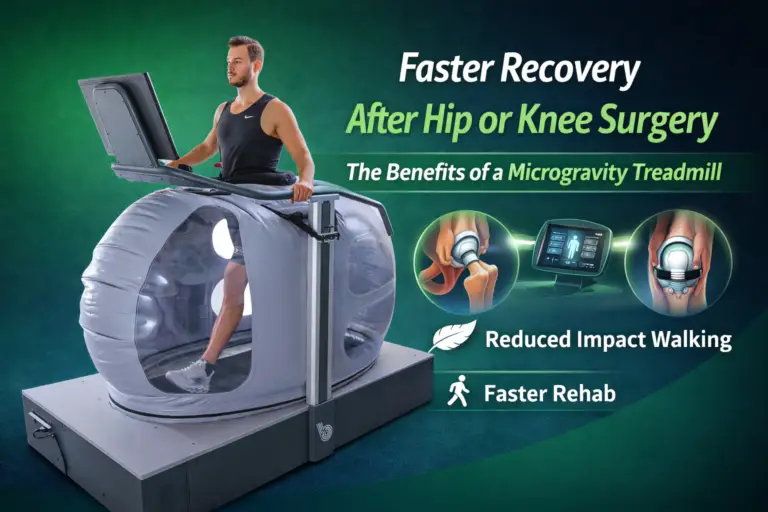
Hip and knee replacements are often described as life-changing operations, and for many people, they are. Joint replacement surgery is common and generally successful, but the operation is only part of the story. What really shapes the outcome is what happens afterwards, when you are trying to rebuild strength, confidence and a walking pattern that actually feels normal again.
That is where people often get stuck.
You know you need to move.
You know walking matters.
You know strength has to come back.
But your body does not always feel ready for full weight-bearing movement as quickly as your brain would like. Walking can feel awkward, stiff or slightly uncertain. The joint may be healing well, but confidence is lagging behind.
This is exactly where a Microgravity Treadmill can make a real difference.
At We Fix Feet, our system allows you to walk or run with anywhere from 100 per cent of your body weight down to 20 per cent, using differential air pressure to reduce the load on the lower body. The aim is simple: make movement feel safer, smoother and more achievable while you rebuild
Why recovery after joint replacement can feel slow
A lot of people assume the hardest part is the operation.
In reality, the more frustrating part is often the weeks that follow.
You are caught between two messages:
- move early, because movement matters
- do not overload the joint too quickly
Both are true.
Early walking helps with stiffness, circulation, muscle activation and restoring function. The problem is that early walking at full body weight can feel uncomfortable, and sometimes quite intimidating, especially if you are not yet trusting the new joint. The article you shared highlights the same balance, explaining that people need to move early after surgery to avoid stiffness, muscle loss and loss of confidence, but without putting too much strain on the healing area.
That tension is exactly why reduced-load rehab works so well.
What a Microgravity Treadmill actually does
The key difference is load.
A Microgravity Treadmill uses differential air pressure to support part of your body weight, which means you can walk with less pressure going through the hips, knees, ankles and feet. The system allows very precise changes to support, which means progression can be gradual rather than guesswork.
In practical terms, that means if full-weight walking feels too uncomfortable or too early, you do not have to choose between pushing through it and stopping altogether.
You can still move.
You can still practise gait.
You can still rebuild confidence.
You are just doing it at the right load for where your body is now.
That is a very different proposition.
Why does this matter after hip or knee replacement
After joint replacement, people usually want the same thing.
They want to get back to walking normally as quickly as possible.
Not “walking a bit.”
Not shuffling carefully.
Not thinking about every step.
They want to feel steady, capable and more like themselves again.
A reduced-load treadmill helps with that because it gives you a way to practise walking mechanics without asking the body to absorb a full load too early. The source article describes this as helping people walk further and for longer with less discomfort, while also restoring more normal gait patterns.
That matters for a few reasons.
1. It helps rebuild walking confidence
One of the biggest barriers after surgery is not always pain. Sometimes it is hesitation.
You are aware of the joint.
You are cautious on each step.
You do not fully trust it yet.
Reduced-load walking provides a safer environment for people to start rebuilding that trust. The enclosed and supported feel of bodyweight-supported treadmill work is often described as improving confidence and reducing fear of falling.
2. It allows earlier, more comfortable movement
When walking is more comfortable, people tend to move better. When movement feels less threatening, they are also more likely to do it consistently.
That consistency matters more than heroic effort.
3. It helps restore a more natural gait
After surgery, it is easy to pick up compensations. Shorter steps, uneven loading, cautious turns, and guarded walking can all become habits if left unaddressed.
A Microgravity Treadmill allows you to work on gait without asking the body to tolerate full force immediately. The shared article points to improvements in walking speed, step length and knee range of motion with bodyweight-supported treadmill rehab after knee replacement.
It is not just about comfort. It is about progression
This is the part that matters most to a Ben-type reader.
You do not want just “easier.”
You want smarter progression.
That is what this gives you.
At We Fix Feet, this is not sold as a gimmick or a novelty treadmill session. It is a structured loading tool. Your starting point can be set based on what your body currently tolerates, and the support can then be reduced gradually over a programme of sessions. The service outline in your own plan makes this very clear, especially for post-op and osteoarthritis clients, where pain-guided walking, higher unweighting and confidence-building are part of the progression model.
In other words, this is not “less walking.”
It is better to walk.
What can this help you do in real life
After hip or knee replacement, the real goal is not just completing rehab sessions.
It is getting back to normal life with less effort and less worry.
That might mean:
- walking to the shops without thinking about the joint
- feeling more stable on uneven ground
- handling longer distances
- rebuilding confidence on stairs or slopes
- returning to exercise in a way that feels sensible, not rushed
The source article uses examples such as improved community walking and reduced reliance on walking aids, which fit well with how this type of support is usually used in practice.
That is why this matters. Because walking confidence affects much more than your rehab programme. It affects independence, mood, activity levels and how quickly life starts feeling normal again.
Why is this different from “just walking more”
People are often told to walk after surgery.
That advice is not wrong. It is just incomplete.
Walking more is only helpful if the body can tolerate it well enough, and if the quality of movement is not falling apart in the process.
If walking is painful, cautious or highly compensatory, simply doing more of it is not always the smartest answer.
Reduced-load walking gives you a middle ground.
It allows exposure to movement without forcing full impact too soon. That is exactly the logic behind your own Low-Impact Rehab & Confidence Walking Programme, which is designed for people who need confidence, cardiovascular exposure and movement without flare-ups.
Is it just for older or less active people?
Not at all.
One of the strengths of this approach is that it can be used across a wide range of goals.
Some people use it because they simply want to walk more comfortably after surgery.
Others use it because they want to recover better, rebuild more efficiently, and return to higher levels of activity. Your own treadmill service plan positions it for both rehab and performance, including walking programmes, return-to-run pathways and maintaining conditioning during recovery.
So no, this is not about being “frail.”
It is about using the right tool at the right stage of recovery.
Final thought
Hip and knee replacement surgery can give people a huge opportunity to move better again, but the gap between surgery and full confidence is where a lot of frustration lives.
A Microgravity Treadmill helps bridge that gap.
It reduces load, supports better movement, and gives you a more controlled way to rebuild walking confidence and strength. It does not replace rehab. It accelerates the parts of rehab that matter most: safe movement, progressive loading and restoring trust in your body.
If you are recovering from hip or knee replacement and want a more confident, more structured route back to walking properly, this is one of the smartest tools available.
Next step
If you are recovering after hip or knee replacement and want to know whether reduced-load walking could help you progress more comfortably, the best next step is to book an appointment or speak to the clinic.
A proper assessment can help you understand whether this is the right stage, the right approach and the right next move for your recovery.