

The Smartest Way to Train When Your Body Isn’t Fully Cooperating
If you’re serious about performance, setbacks are frustrating.
You train hard. You manage your workload. You stretch. You lift. You recover properly.
And yet… your knee flares up.
Your hip feels restricted.
Your Achilles starts grumbling again.
Or you’ve had surgery, and now you’re stuck wondering how to rebuild safely without losing everything you’ve worked for.
Here’s the truth: most people don’t realise:
Traditional rehab often forces you to choose between two bad options.
Train through discomfort and risk of worsening it.
Or stop completely and lose fitness, confidence and momentum.
There’s a third option.
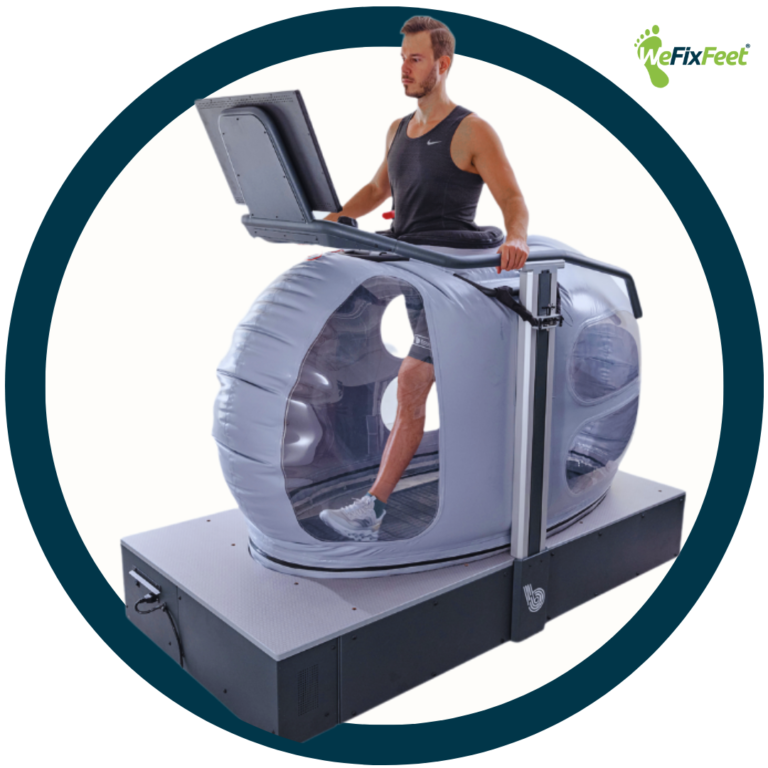
It’s called Microgravity training.
And we’re the only clinic in Nottingham that offers it.
What Is a Microgravity Treadmill?
The Microgravity treadmill uses differential air pressure technology to reduce your bodyweight while you walk or run.
That means:
You can train at 70%, 60% or even 50% of your bodyweight.
You maintain normal gait mechanics.
You continue cardiovascular conditioning.
But your joints experience significantly less impact.
For runners, that means you can run earlier in recovery.
For post-op clients, that means controlled progression.
For arthritic joints, that means movement without overload.
This is not a gimmick treadmill.
It is performance-controlled loading.
And when used correctly by experienced clinicians, it changes recovery timelines.
Why High Performers Use It
Elite sport adopted this technology years ago.
Because they understand something important:
Complete rest is rarely the fastest way back.
Controlled load is.
When the load is removed entirely, tissues decondition.
When the load is too high, tissues flare.
The Microgravity treadmill allows us to find the exact point between those two extremes.
This is especially powerful if you are:
- Returning from hip or knee surgery
- Managing chronic knee pain
- Recovering from a running injury
- Trying to maintain performance while managing symptoms
- Working through arthritic joint pain
- Reducing load during weight loss or return-to-training phases
For someone like you, this is about momentum.
Not just pain reduction.
Why This Matters for Runners and Athletes
Let’s speak directly.
If you’re training for an event, a performance drop-off is expensive.
It costs you conditioning.
It costs you rhythm.
It costs you confidence.
Most runners wait too long to address small issues.
They push.
They compensate.
Then something gives.
The Microgravity treadmill allows you to:
- Maintain cadence while reducing impact
- Rebuild confidence in stride mechanics
- Increase the load gradually
- Return to outdoor running earlier
- Avoid complete shutdown periods
This is not about “taking it easy.”
It’s about intelligent progression.
Post Hip or Knee Surgery? This Is Where It Changes Everything.
After hip or knee surgery, patients are often told to walk.
But walking at full bodyweight can be uncomfortable and limiting in early phases.
Microgravity allows:
- Reduced joint compression
- Earlier gait retraining
- Controlled walking progression
- Confidence without fear
- Structured reloading
Instead of waiting for swelling to calm down before progressing, we adjust bodyweight and continue movement safely.
That means strength returns sooner.
Neuromuscular control improves earlier.
And your confidence rebuilds faster.
What About Arthritis?
If you have arthritic joint pain, impact is often the limiting factor.
But avoiding movement entirely accelerates stiffness and muscle loss.
With Microgravity:
- We reduce compressive force
- Maintain natural movement patterns
- Improve circulation
- Build muscular support
- Increase tolerance gradually
This isn’t “light exercise.”
It’s controlled therapeutic loading.
Is This Just for Rehab?
No.
It is also a performance tool.
We use it to:
- Increase running volume without overloading tissues
- Improve cadence and stride mechanics
- Fine-tune return-to-run protocols
- Maintain training during minor flare-ups
- Improve metabolic conditioning with lower joint stress
For high-performing professionals, this means fewer forced rest blocks.
It means smarter training cycles.
Why Nottingham Hasn’t Had This Until Now
Because it requires:
- Investment
- Clinical expertise
- Proper integration into rehab pathways
We are currently the only clinic in Nottingham offering this technology.
And more importantly, it is led by:
- HCPC Registered Podiatrists
- Sports Therapists
- MSK Rehabilitation specialists
This is not a gym treadmill with air pressure.
It is integrated into a full performance and recovery system, including:
- Biomechanical Assessment
- Shockwave Therapy
- K-Laser Therapy
- Rehab Gym Programming
- Structured Recovery Plans
Technology without clinical reasoning is noise.
Technology inside a structured plan is leveraged.
What Does a Microgravity Assessment Include?
We do not simply “put you on the treadmill.”
Your session includes:
- Clinical review of your injury or performance goal
- Movement and loading assessment
- Controlled bodyweight reduction trial
- Gait analysis under reduced load
- Progressive reloading plan
- Clear return-to-training roadmap
You leave knowing:
- Your safe starting load
- Your progression schedule
- Your realistic timeline
- And whether this fits into a larger recovery plan
This is structured.
Not experimental.
What Does It Cost?
A Microgravity Assessment is £149 for a one-hour appointment.
That includes clinical assessment, treadmill trial and progression strategy.
For many clients, this becomes part of:
- MSK Recovery Plan (£1395)
- MSK Reboot Plan (£795)
- Or integrated rehabilitation pathways
The question is not whether it costs money.
The question is whether it reduces:
- Time off training
- Risk of re-injury
- Prolonged recovery
- Lost performance cycles
For most performance-driven individuals, the answer is clear.
Is It Right for You?
It may not be necessary if:
- You are pain-free
- You are not training
- You are content with slow recovery
It is likely appropriate if:
- You want structured progression
- You want faster recovery
- You want to maintain fitness while injured
- You want expert oversight
- You value intelligent rehab over guesswork
The Bigger Picture
Most injuries are not catastrophic.
They are a mismanaged load.
Most prolonged recoveries are not unavoidable.
They are poorly progressed in rehab.
Microgravity allows us to manage load precisely.
That is the difference
Final Thought
If performance matters to you, downtime is not neutral.
It costs momentum.
It costs confidence.
It costs progress.
The Microgravity treadmill is not about avoiding work.
It is about doing the right work, at the right load, at the right time.
And right now, we are the only clinic in Nottingham offering it under podiatry and sports therapist supervision.
If you want to train smarter and recover faster:
Or speak to a member of our team to see if it fits your recovery or performance plan.
Because intelligent progression beats forced rest.
Every time.