






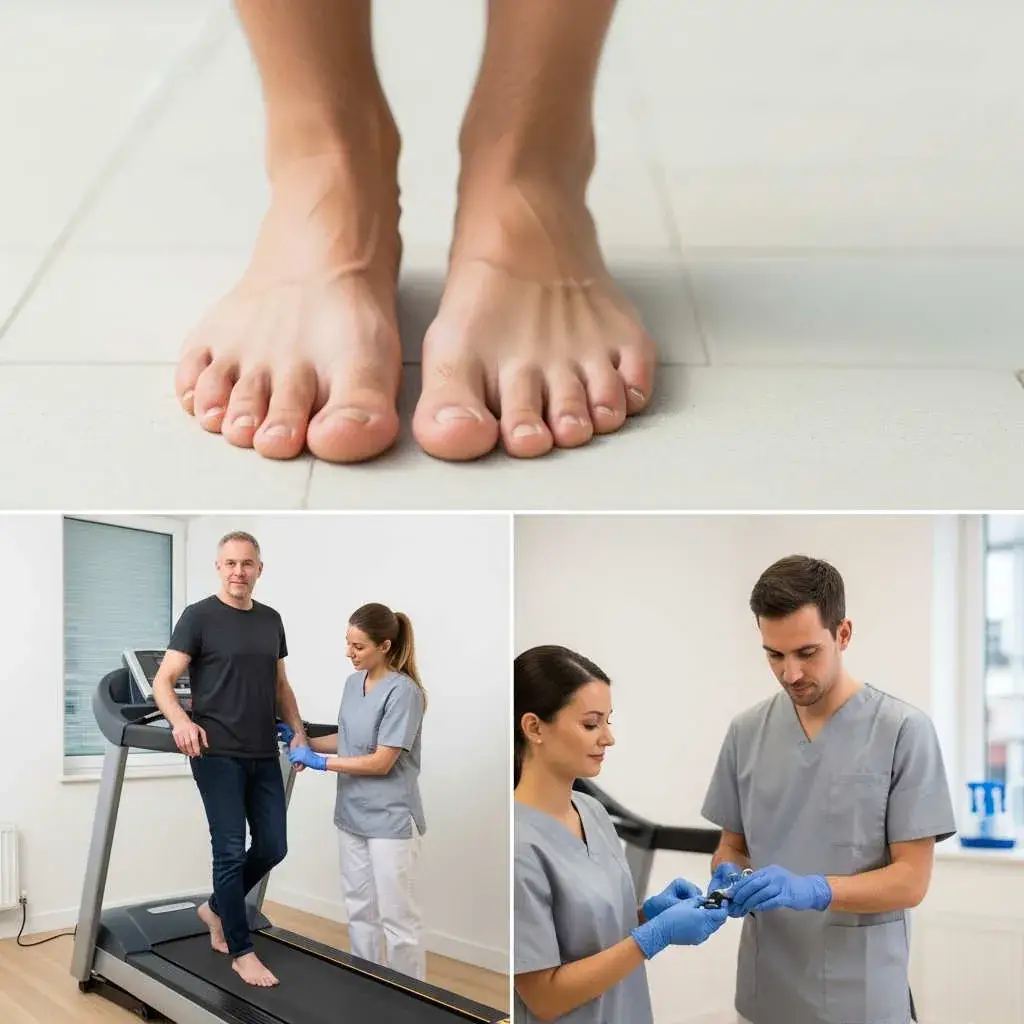


Supporting Safer, More Confident Walking After Neurological Change
Neurological conditions can make walking feel uncertain — affecting balance, endurance, and confidence in everyday movement.
At We Fix Feet, we provide calm, specialist walking support designed to help some people walk with greater stability and confidence, working alongside families, carers, and existing NHS or private care teams.
No obligation. No promises. Just clarity.
Who This Support Is For
This service may be appropriate for adults who:
- Are living with a neurological condition such as stroke, Parkinson’s disease, multiple sclerosis, or cerebral palsy
- Experience changes in walking, balance, confidence, or fatigue
- Feel uncertain or nervous about walking, especially outdoors or over longer distances
- Are already under NHS or consultant care and want additional, carefully supported walking practice
- Have family members or carers involved in their decision-making
Who This May Not Be Suitable For
This service may not be appropriate for people who:
- Are unable to take part in supported walking, even with assistance
- Have unstable medical conditions where walking practice has not been approved
- Are seeking a cure, guaranteed improvement, or rapid results
- Require urgent medical or neurological intervention
- Have been advised by their medical team to avoid walking-based rehabilitation at this stage
Important to Know
- Suitability is discussed with a clinician before any treatment begins
- Support is personalised and may change over time
- This service complements existing neurological care — it does not replace it
Unsure if this is the right next step?
This conversation is suitable for individuals, family members, and carers.
We’ll help you understand whether supported walking is appropriate — or advise if it isn’t.
What Improvement Can Look Like
(This varies from person to person)
Neurological change affects everyone differently. Improvement is not about “fixing” walking — it is about supporting safer, more confident movement where possible.
For some people, progress may look like:
- Walking a little further before needing to rest
- Feeling steadier when walking indoors or on familiar routes
- Practising walking without the same level of fear or tension
- Improving confidence when starting or stopping movement
- Better tolerance for everyday activities such as short outings or household tasks
Changes may be gradual and subtle. For others, the benefit may be reassurance, guidance, or confirming whether supported walking is appropriate at this stage.
Important to Understand
- Progress is individual and not guaranteed
- Support focuses on safety, confidence, and functional movement
- Walking ability can fluctuate, and care is adapted accordingly
Why Supported Walking Can Be Helpful After Neurological Change
After neurological change, walking is often affected by a combination of physical effort, balance demands, and fear of falling — not just strength alone.
Supported walking allows some people to practise walking in a way that feels safer and more controlled.
By reducing the amount of body weight passing through the legs, supported walking can:
- Lower the physical effort required to take each step
- Reduce fear and tension that can interfere with movement
- Allow walking practice earlier or for slightly longer durations
- Create a calmer environment to focus on rhythm, balance, and confidence
This can be particularly helpful where fatigue, instability, or anxiety limit how much walking someone feels able to attempt.
Important Context
Supported walking is not a treatment for neurological conditions.
It is one tool within a wider rehabilitation approach and is used selectively, based on individual assessment and clinical judgement. For some people, it may help build confidence and tolerance for walking. For others, it may help clarify whether walking-based rehabilitation is appropriate at this stage.
Why This Is Different From Standard Walking Practice
Traditional walking practice often requires full body weight and balance demands from the start.
Supported walking can reduce those demands, allowing movement to be explored in a safer, more controlled way — particularly when confidence or endurance is limited.
What the Pathway Typically Looks Like
(Structure, not a commitment)
Step 1 — Clinical Suitability Conversation
A calm conversation with a clinician to understand:
- The neurological condition and current walking concerns
- Confidence, fatigue, and balance considerations
- Existing NHS or consultant care
- Whether supported walking may be appropriate at this stage
This step is suitable for individuals, family members, and carers.
Step 2 — Supported Walking Assessment
If supported walking is considered suitable, we carry out a careful, supervised assessment.
This allows us to:
- Observe walking tolerance and confidence
- Adjust support levels to prioritise safety
- Understand how fatigue and balance respond to supported walking
This assessment does not commit you to ongoing sessions.
Step 3 — Carefully Progressed Support
Where supported walking appears helpful, sessions are tailored to the individual.
Progress may involve:
- Gradual changes in walking duration or support
- Monitoring fatigue, confidence, and safety
- Regular review to ensure the approach remains appropriate
Support can be paused, adjusted, or stopped at any point.
How Progress Is Considered
Where supported walking appears helpful, sessions are tailored to the individual.
Progress may involve:
- Gradual changes in walking duration or support
- Monitoring fatigue, confidence, and safety
- Regular review to ensure the approach remains appropriate
Support can be paused, adjusted, or stopped at any point.
Important to Know
- Not everyone progresses through every stage
- This pathway complements existing neurological care
- Clinical judgement guides every decision
Clinical Oversight & Experience
All walking and mobility support at We Fix Feet is guided by HCPC-registered clinicians with experience supporting complex lower-limb and neurological movement challenges.
Our role is not to replace neurological or medical care, but to work alongside it — helping ensure that any walking support is appropriate, considered, and safely delivered.
We routinely support people who are:
- Under NHS or consultant-led neurological care
- Recovering or adapting after neurological change
- Seeking carefully supervised walking support rather than generic exercise programmes
Clinical decisions are made conservatively, with safety and suitability prioritised at every stage.
WORKING ALONGSIDE EXISTING CARE
Where appropriate, we encourage:
- Ongoing involvement of NHS teams
- Input from family members and carers
- Clear communication around what is — and is not — appropriate
This ensures supported walking fits within the wider picture of neurological care.
For Families and Carers
Supporting someone after neurological change can feel complex and emotionally demanding. Many families and carers are balancing safety concerns, uncertainty about progress, and the fear of pushing too hard or doing the wrong thing.
We recognise that decisions about walking support are often shared decisions.
That’s why our approach includes:
- Time to talk things through without pressure
- Clear explanations of what may — or may not — be appropriate
- Involvement of family members or carers in suitability conversations, if helpful
Sometimes the most valuable outcome is clarity — understanding whether supported walking is the right step now, later, or not at all.
This is a programme, not a one-off session.
Walking confidence improves when:
- Practice is consistent
- Progression is guided
- Support is available
If you’re looking for reassurance without structure, this may not be right.
If you want support staying active long-term — it often is.
Request a Specialist Conversation
If you’d like:
- Honest guidance
- Specialist input
- A calm discussion about mobility support
You can request a specialist conversation.
Frequently Asked Questions (FAQs)
Is this suitable for all neurological conditions?
Support is tailored individually. A conversation helps determine suitability.
Can this help long-standing conditions?
Yes — support can be helpful at many stages, depending on goals.
Do you work with carers and families?
Absolutely. Support often works best when families are involved.
Is this a replacement for physiotherapy?
No — it complements existing care where appropriate.
What to do next
If you’re ready to move forward — without guessing or pushing through pain — the next step is simple.
- Fill in the form to request a Call From Our Team
- One of our team will call you for FREE and answer any questions or concerns you may have.
Our Clinic Locations
We have two convenient locations in Beeston and Ilkeston, making expert podiatry and sports rehabilitation accessible across Nottinghamshire and Derbyshire.
Ilkeston Clinic
- Open: Mon-Fri 09:00AM - 05:00PM / Sat 09:00AM - 01:00PM
- 94 Bath Street, Ilkeston, Derbyshire DE7 8FE
- +44 115 932 8832
- enquiries@wefixfeet.co.uk
Beeston Clinic
- Open: Mon-Fri 09:00AM - 05:00PM / Sat 09:00AM - 01:00PM
- 36a The Square, Beeston, Nottinghamshire NG9 2JJ.
- +44 115 922 3377.
- enquiries@wefixfeet.co.uk
Testimonials
Before You Book Your Appointment, Here’s Just A Handful Of Our Patients Success Stories To Put Your Mind At Ease


I had an ingrown toenail which I had left way too long and had become infected. I finally plucked up the courage to visit We Fix Feet in Ilkeston. My only regret is not visiting sooner! Ronnie was able to remove the portion of ingrown toenail at my first appointment, and within a day or two, my nail was perfect. After hiding my feet for many years I finally have a healthy set of toenails and have treated myself to my first ever pair of open toe sandals! All the staff here are wonderful, professional and very reassuring for which I am very grateful. Thank you

I had an ingrown toenail which I had left way too long and had become infected. I finally plucked up the courage to visit We Fix Feet in Ilkeston. My only regret is not visiting sooner! Ronnie was able to remove the portion of ingrown toenail at my first appointment, and within a day or two, my nail was perfect. After hiding my feet for many years I finally have a healthy set of toenails and have treated myself to my first ever pair of open toe sandals! All the staff here are wonderful, professional and very reassuring for which I am very grateful. Thank you