

Verruca or Corn – How to Tell the Difference
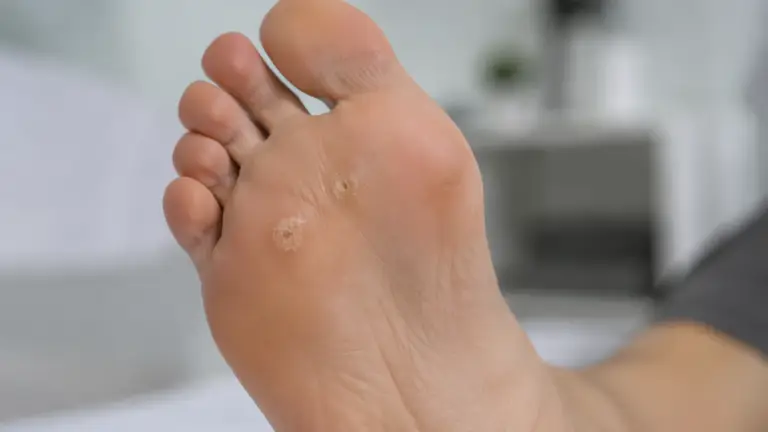
At first glance, verrucas and corns can look surprisingly similar.
They can both appear as small areas of thickened skin. They can both become painful when you walk. They can both sit under pressure points on the foot. And they can both leave people staring at the bottom of their feet, wondering what on earth they are actually dealing with.
That confusion matters more than people realise.
Because if you treat a corn like a verruca, or a verruca like a corn, you can waste time, money and patience very quickly. You can also end up irritating the area without solving the real problem.
So let’s make this simple.
If you are trying to work out whether you have a verruca or a corn, the most important thing to understand is this:
they are not the same thing, even if they can look similar at first.
One is usually caused by pressure. The other is caused by a viral skin infection.
That difference changes everything, including the best way to manage it.
What is a corn?
A corn is a small, localised area of hard skin that forms because of pressure or friction.
It usually develops where the foot is loaded or repeatedly rubbed. That might be because of footwear, how the foot moves, prominent joints, toe shape, or the way pressure travels through the foot when you walk.
Corns are not contagious. They do not spread like a verruca. They are essentially a sign that the skin is trying to protect itself from repeated stress.
The problem is that the protection becomes a problem in its own right.
A corn can become sharply painful, especially when direct pressure is applied.
What is a verruca?
A verruca is a wart on the foot caused by the human papillomavirus, often shortened to HPV.
It affects the outer layer of skin and commonly appears on the sole of the foot or around the toes. Because it is on a weight-bearing part of the body, it often pushes inward rather than growing outward like warts elsewhere.
That can make it look flatter, more stubborn and sometimes more painful than people expect.
Unlike a corn, a verruca is viral. That means it can spread and behave differently.
Why do people confuse them
The confusion usually happens because both can:
- sit on the sole of the foot
- hurt when walking
- have hard skin over the top
- look round or well-defined
- Seems small but feel very annoying
If someone searches online, they will often find general photos that do not help much because real feet rarely look as neat or textbook as the internet would like them to.
That is why proper assessment can be so useful. But before we get to that, let’s talk through the clues people notice most.
Clue 1: Where is the pain?
This is one of the most useful starting points.
A corn often hurts because of direct pressure. Many people describe it as a very focused, sharp pain, as if something hard is pushing into the foot. It can feel quite pinpointed.
A verruca may also hurt under pressure, especially on weight-bearing skin, but the discomfort can feel slightly different. Some people describe it as tenderness, pressure or soreness rather than the sharp “stone in the shoe” feeling that corns often produce.
That said, pain alone is not sufficient to properly diagnose either.
Clue 2: What does the skin look like?
A corn usually looks like a concentrated area of hard skin. It may have a denser central core, especially if it is well established. The skin lines often continue across it, though it can be difficult to judge whether there is a lot of callus.
A verruca more often interrupts the normal skin pattern. It may have a rougher appearance and sometimes shows tiny dark spots, which are often clotted capillaries. Not every verruca shows them clearly, but when they are visible, they are a useful clue.
Again, this is where people can go wrong. Thick, hard skin can mask the underlying appearance of both.
Clue 3: Is it spreading?
his is a particularly useful question.
A corn usually stays as a pressure-related lesion. It may get bigger if the pressure continues, but it does not spread because it is not infectious.
A verruca can spread, either by growing locally or by appearing in clusters. If you start noticing multiple similar lesions, especially in nearby skin, a verruca becomes much more likely.
That does not mean every single verruca spreads dramatically. Some stay localised. But spreading is much more characteristic of a verruca than a corn.
Clue 4: What happens if you trim or treat it yourself?
This is where many people accidentally make things worse.
If you treat a corn with over-the-counter products, especially strong acids, you may simply irritate the healthy skin around it without relieving the pressure that caused it.
If you treat a verruca like a corn by reducing hard skin only, you may feel temporary relief, but leave the underlying viral tissue untouched.
This is exactly why a correct diagnosis matters.
The wrong treatment is not just ineffective. It can delay the right one.
How a podiatrist tells the difference
A professional assessment is not based on one single clue.
A podiatrist will usually look at:
- the location
- the shape and skin pattern
- whether there is hard skin masking it
- pain behaviour
- pressure points
- whether there are signs of viral tissue
- whether it is isolated or spreading
- How long it has been there
- What has already been tried
In many cases, this makes the diagnosis much clearer very quickly.
The benefit is not just having a name for it. The benefit is knowing what actually needs to be done next.
Why it matters to get it right
If it is a corn, the plan may involve reducing the lesion and then working out why the pressure is there in the first place. Otherwise, it can simply return.
If it is a verruca, the conversation becomes about whether it needs treatment, what type of treatment is appropriate, and whether what you have already tried is actually likely to work.
The important point is this:
The right diagnosis saves wasted effort.
That is especially important for private patients who want a clear answer and a sensible next step, not weeks of trial and error.
Can you have both?
Yes, occasionally things can become messy.
A verruca can develop hard skin over it due to pressure, making it look more corn-like. A pressure lesion can also become more confusing visually if someone has been trying to treat it for a while.
That is another reason why self-diagnosis is not always reliable.
Final thought
If you are looking at the bottom of your foot thinking, “I’m not actually sure what this is,” you are not alone.
Verrucas and corns are easy to confuse, especially once hard skin builds up or walking starts making the area more painful.
The good news is that they are usually distinguishable once properly assessed.
And that matters, because the right treatment starts with knowing what you are actually dealing with.
Next step
If you are not sure whether you have a verruca or a corn, the next best step is to book an appointment or speak to the clinic.
A proper assessment can give you clarity quickly and help you avoid wasting time on the wrong treatment.