
A practical, evidence-based guide for anyone who wants to protect their bones before problems start
Quick answer
You protect your bone density by combining enough calcium and vitamin D, regular weight-bearing and resistance exercise, not smoking, keeping alcohol within moderate limits, and knowing your risk early enough to act on it. None of this needs to be complicated, and it works best when you start before you notice a problem, not after.
Key takeaways
- Bone loss has no symptoms until a fracture happens, which is why most people find out too late rather than too early.
- In the UK, around 3.5 million people have osteoporosis, and it causes more than 500,000 broken bones every year, one every minute.
- Half of women and around one in five men over 50 will break a bone because of osteoporosis at some point.
- Calcium, vitamin D, and the right kind of exercise are the foundation of prevention, and all three matter, not just one.
- A bone density check tells you where you actually stand, rather than leaving you to guess.
Why this matters more than it feels like it does
Bone loss doesn’t hurt. There’s no ache that tells you your bones are thinning, no warning sign before it becomes a problem. Most people only find out their bone density is low after they’ve already broken something, often from a fall that wouldn’t have injured someone with stronger bones.
That’s not a small issue. Osteoporosis is estimated to affect around 3.5 million people across the UK, and it’s behind more than 500,000 fragility fractures every year, roughly one every minute of every day. Half of women and about one in five men over 50 will break a bone as a direct result of it. These fractures aren’t minor. A hip fracture in particular can mean months of recovery, a loss of independence, and for some people, it changes what the rest of their life looks like.
None of this is inevitable. Bone density loss can be slowed, and in many cases prevented from becoming a real problem, through steps that are well understood and not especially complicated. The difficulty is usually timing: most people only start paying attention once something has already gone wrong.
What’s actually happening as you get older
Bone is living tissue. It’s constantly being broken down and rebuilt in a process that continues your whole life. Up until around your early thirties, you build slightly more bone than you lose, which is why bone density peaks in early adulthood. After that, the balance gradually tips the other way, and you lose slightly more than you rebuild.
For women, this shift speeds up noticeably around menopause. Oestrogen plays a protective role in slowing bone breakdown, and when oestrogen levels fall, that protection drops away too. It’s one of the main reasons bone density loss accelerates for women in their late forties and fifties, often well before anyone’s thinking about it as a bone health issue rather than a menopause issue.
Men lose bone density too, just more gradually and later, which is partly why it’s often missed in men until later stages.
Getting enough calcium and vitamin D
Calcium is the main mineral your bones are built from. If you’re not getting enough through your diet, your body will draw it from your skeleton to keep your blood calcium levels stable, which weakens bone over time. NHS guidance puts adult calcium needs at around 700mg a day, which is achievable through diet for most people: dairy products, tinned fish with bones such as sardines, leafy green vegetables, and calcium-fortified plant milks and cereals all contribute.
Vitamin D is what allows your body to actually absorb that calcium. Without enough of it, extra calcium in your diet doesn’t do much good, because it can’t get to where it’s needed. UK government guidance recommends everyone consider a daily supplement of 10 micrograms of vitamin D, particularly across autumn and winter when sunlight exposure isn’t enough to maintain levels, and year-round for anyone with limited sun exposure or higher risk factors.
If you’re unsure whether your diet is meeting your calcium needs, or whether you should be supplementing vitamin D, it’s worth checking rather than assuming either way.
The exercise that actually builds bone
Not all exercise affects bone density the same way. Bone responds to load, meaning it gets stronger in response to being asked to bear weight or resist force. This is why swimming and cycling, while excellent for cardiovascular fitness, do relatively little for bone density on their own.
Two types of activity make the biggest difference:
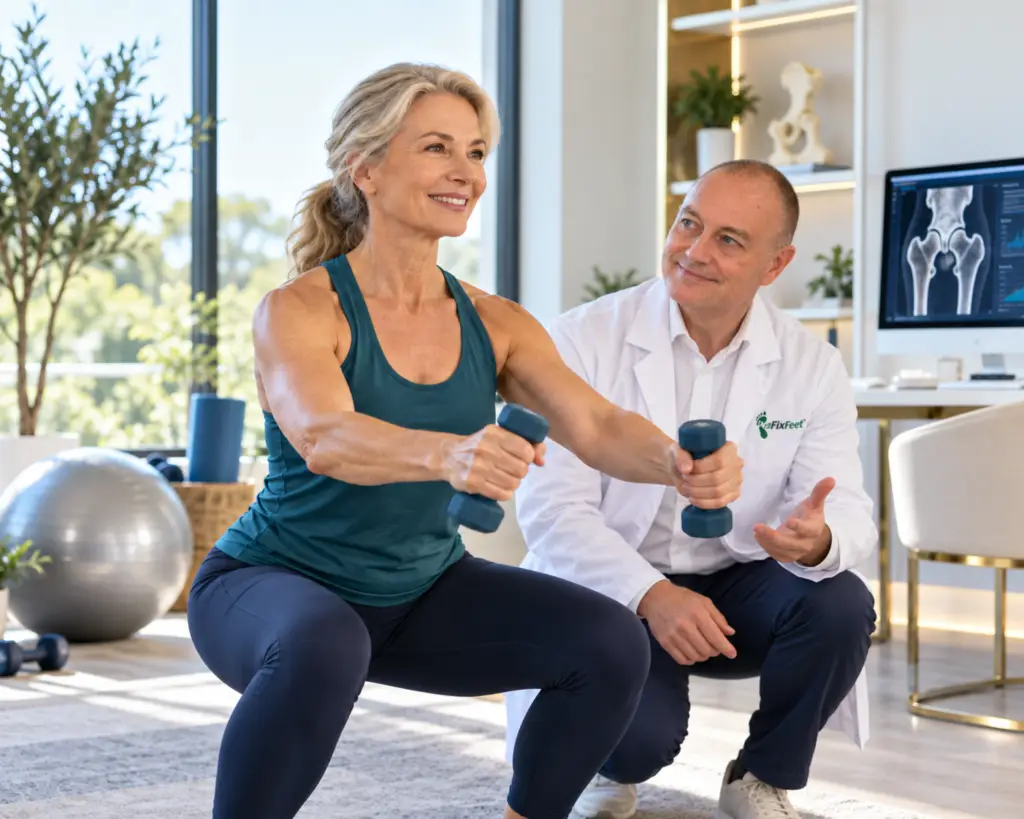
- Weight-bearing impact exercise — walking briskly, dancing, jogging if it’s appropriate for you, or anything where your feet are working against gravity. This signals to your body that your bones need to stay strong to keep up with what you’re asking of them.
- Resistance training — using weights, resistance bands, or your own body weight to work against tension. This builds muscle, and the pull of muscle on bone is itself a stimulus for bone strength, which is part of why resistance training and impact exercise work well together rather than as alternatives.
The goal isn’t intensity for its own sake. Consistency across weeks and months is what makes the difference, not a handful of hard sessions.
The habits worth paying attention to
A few everyday factors have a disproportionate effect on bone health:
- Smoking measurably lowers bone density and increases fracture risk. Stopping is one of the most effective single changes available, and the benefit to bone health builds over time after quitting.
- Alcohol above moderate levels interferes with calcium balance and the hormones involved in bone repair. Staying within recommended limits protects bone as well as general health.
- Very low body weight is a genuine risk factor, not just very high weight. Being underweight is associated with lower bone density, so this isn’t only a conversation about avoiding excess weight.
None of these require dramatic change. They’re the kind of steady, unglamorous habits that add up over years, which is exactly how bone density changes in the first place.
Knowing where you actually stand
Everything above helps, but none of it tells you your actual bone density. The only way to know that is to have it measured.
NICE guideline NG187 recommends that anyone with risk factors for osteoporosis, such as being postmenopausal, having a family history of fracture, or having previously broken a bone from a minor fall, should have their fracture risk formally assessed, typically using a tool such as FRAX. Depending on the result, this can lead to a bone density scan.
The traditional route to a scan is via your GP, usually after a fracture risk assessment flags it as appropriate, and NHS scanning uses DEXA (Dual-Energy X-ray Absorptiometry), a low-dose X-ray scan.
At East Midlands Bone Health Centre, we use EchoLight REMS (Radiofrequency Echographic Multi Spectrometry) scanning, which measures bone density using sound waves rather than radiation. It’s available without a GP referral, which means you don’t need to wait until a risk assessment flags a concern to find out where you stand. A scan takes around 20 minutes and gives you a clear picture of your bone density against expected ranges for your age.
We also offer an optional blood panel alongside the scan, covering markers relevant to bone metabolism including vitamin D, calcium, and parathyroid hormone, processed through Randox’s UKAS-accredited laboratory. Together, the scan and blood panel give a fuller picture than either alone.
If you’re already at higher risk
Some people have more reason than others to act sooner rather than later:
- Women going through or past menopause, given the acceleration in bone loss that comes with falling oestrogen.
- Anyone with a family history of osteoporosis or hip fracture, particularly a parent.
- Anyone who’s already had a fracture from a fall that shouldn’t have caused one, sometimes called a fragility fracture. Having one fracture significantly increases the likelihood of another, which makes this a genuine priority rather than something to monitor casually.
- Runners and athletes, particularly those who’ve had a period of low energy availability, missed periods, or repeated stress fractures, since these can point to lower bone density than would be expected for someone active and otherwise fit.
If any of this applies to you, a bone density scan gives you something concrete to act on, rather than a general sense of concern with nothing to measure it against.
What happens after a scan
If your bone density comes back within the expected range, that’s genuinely useful information, and it gives you a baseline to compare against in future. If it comes back lower than expected, the result isn’t a diagnosis in itself, and it isn’t a reason to panic. It’s a starting point for a proper conversation about what would help, whether that’s specific dietary changes, a more targeted exercise approach, or referral back to your GP where medical treatment may be appropriate.
Where indicated, NICE guidance and the National Osteoporosis Guideline Group set out when bone-strengthening medication should be discussed with a GP. That conversation sits with your GP or specialist, not with us, and we’ll always be clear about where our role ends and theirs begins.
Frequently asked questions
Can bone density loss be reversed?
Bone density can be improved, particularly with consistent resistance and impact exercise combined with adequate calcium and vitamin D, though the extent varies by individual and by how much loss has already occurred. Earlier action generally produces better results than waiting.
Is it worth getting a bone density scan if I have no symptoms?
Yes, in fact that’s the point. Bone density loss has no symptoms until a fracture happens, so waiting for a symptom means waiting too long. A scan gives you a baseline while you can still act on it.
Does menopause definitely mean I’ll get osteoporosis?
No. Menopause increases the rate of bone loss for most women, but it doesn’t mean osteoporosis is inevitable. It does mean this is a sensible time to pay closer attention, through diet, exercise, and a baseline scan if you haven’t had one.
What’s the difference between a REMS scan and a DEXA scan?
Both measure bone density. DEXA uses a low-dose X-ray and is the standard NHS route, usually via GP referral. REMS uses sound waves instead of radiation and is available privately without a referral, which mainly changes how quickly and easily you can access a scan rather than the underlying question it answers.
Do I need to be diagnosed with osteoporosis to start protecting my bones?
No. Everything in this guide, calcium, vitamin D, weight-bearing and resistance exercise, not smoking, moderate alcohol, applies whether your bone density is already low, borderline, or perfectly healthy. Prevention works best applied before there’s a problem to fix.
If you’d like to know where your own bone density actually stands rather than estimating it, a Bone Health Assessment at East Midlands Bone Health Centre includes a REMS scan and, if you choose, the Randox blood panel, with a clear explanation of your results and what they mean for you. Find out more and book an assessment.
Sources: NICE Guideline NG187 (Osteoporosis: assessing the risk of fragility fracture); NICE Quality Standard QS149; Royal Osteoporosis Society; National Osteoporosis Guideline Group (NOGG); NHS guidance on calcium and vitamin D.