
Battling persistent foot or lower limb pain and wondering if a biomechanical assessment is your key to recovery?
This guide offers a transparent, step-by-step look at what our 60-minute assessment involves, helping you understand if it’s the effective solution you’ve been searching for.
Key Takeaways:
- A 60-minute biomechanical assessment is a podiatrist-led deep dive into your lower limb structure, movement, and the root causes of your pain.
- The process includes a thorough discussion of your history and goals, static (non-moving) and dynamic (gait analysis) examinations, plus a review of your footwear.
- Its primary aim is to accurately diagnose conditions like plantar fasciitis or Achilles tendonitis, moving beyond just symptom management.
- This detailed understanding leads to a personalised “package of care,” focusing on long-term relief and getting you back to your activities.
- While ideal for ongoing or complex sports injuries and lower limb conditions, it might not be the first step for very simple, acute issues.
Understanding the Need for a Detailed Assessment
For many active individuals, the world of specialist assessments for conditions like foot pain or heel pain can feel a bit like a black box. You know you need more than a generic approach, especially if you’ve already tried things that haven’t worked.
This type of assessment is often essential when the cause of ongoing discomfort, like that stubborn heel pain or Achilles ache, hasn’t been clearly established.
The uncertainty – not knowing what’s involved, whether it’s thorough enough, or if it will genuinely lead to the answers you need to ‘Treat, Move, Improve’ – is exactly what we want to clarify for you.
Our goal here isn’t to ‘sell’ you an assessment, but to empower you with knowledge.
We believe that when you understand the ‘why’ and ‘how’ behind our comprehensive approach – an approach built on over 35 years of collective experience from our HCPC registered podiatrists and MSK specialist clinicians in understanding lower limb biomechanics – you’re better equipped to choose the right path for your recovery.
Your Biomechanical Assessment: A Step-by-Step Journey
Let’s break down what you can expect during your 60-minute biomechanical assessment with us.
1. The Foundation: Your Story, Your Goals, Your Pain
We start by truly listening. This isn’t a quick chat; it’s a detailed conversation.
Your clinician will want to understand your specific pain – perhaps that sharp heel pain in the morning indicative of plantar fasciitis, or the persistent ache of Achilles tendonitis after a run.
We’ll discuss its history, what makes it better or worse, your activity levels, any previous treatments (and importantly, what hasn’t worked for you), and crucially, your goals. What does getting “back on track quickly” mean for you?
You’ll be speaking with an expert who understands sports injuries and is focused on your individual situation. If you’ve felt rushed or unheard before, you’ll find this different.
This thorough discussion is the bedrock of an accurate diagnosis; it ensures the physical assessment is precisely targeted to your needs, rather than a one-size-fits-all approach that often fails with persistent problems.
It helps us form initial ideas and ensures the tests that follow get to the root of your specific issue.
2. The Static Assessment: Understanding Your Structure
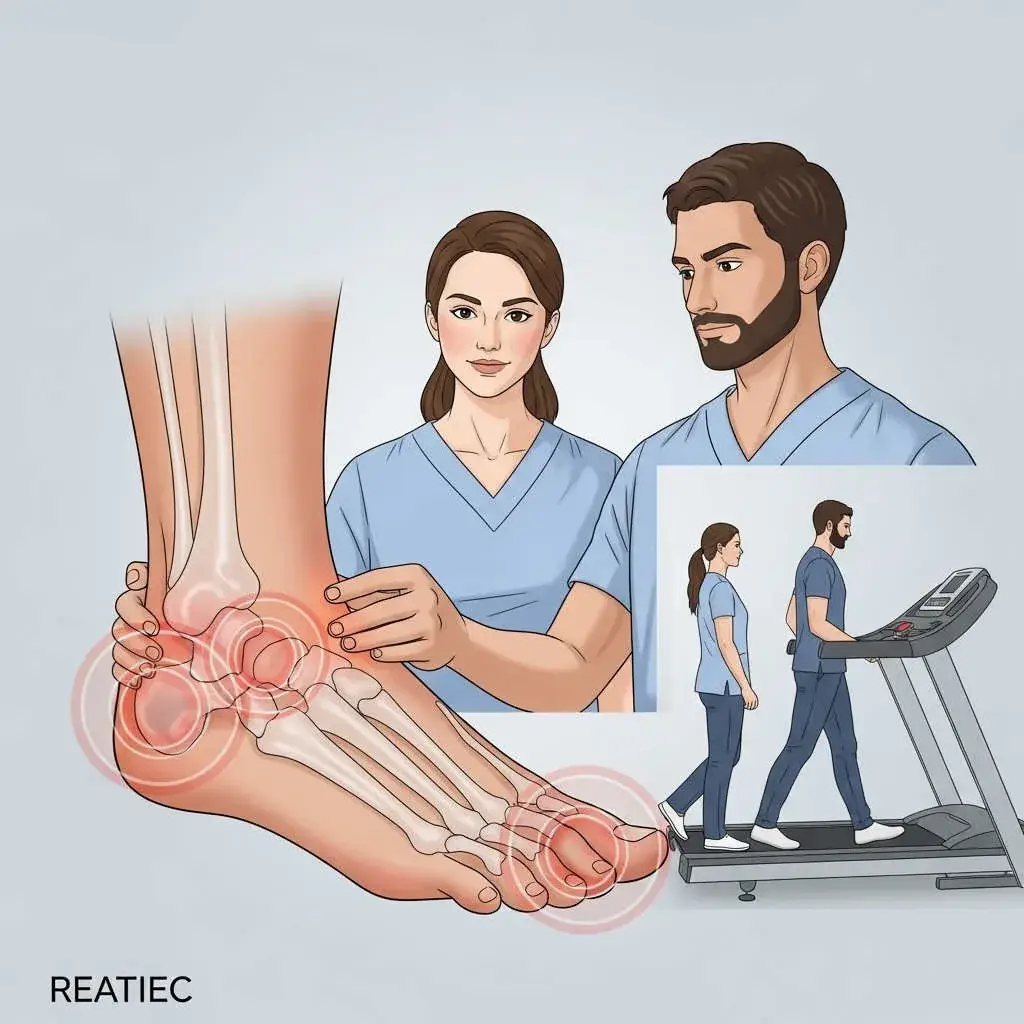
Next, with you comfortably seated, we’ll gently examine your feet and legs – this is the non-weight-bearing part.
We’re looking at your joint range of motion, muscle strength, and specific alignments in your ankles, feet, and even hips. This helps us identify structural factors or restrictions that might be contributing to stress on your plantar fascia or Achilles tendon.
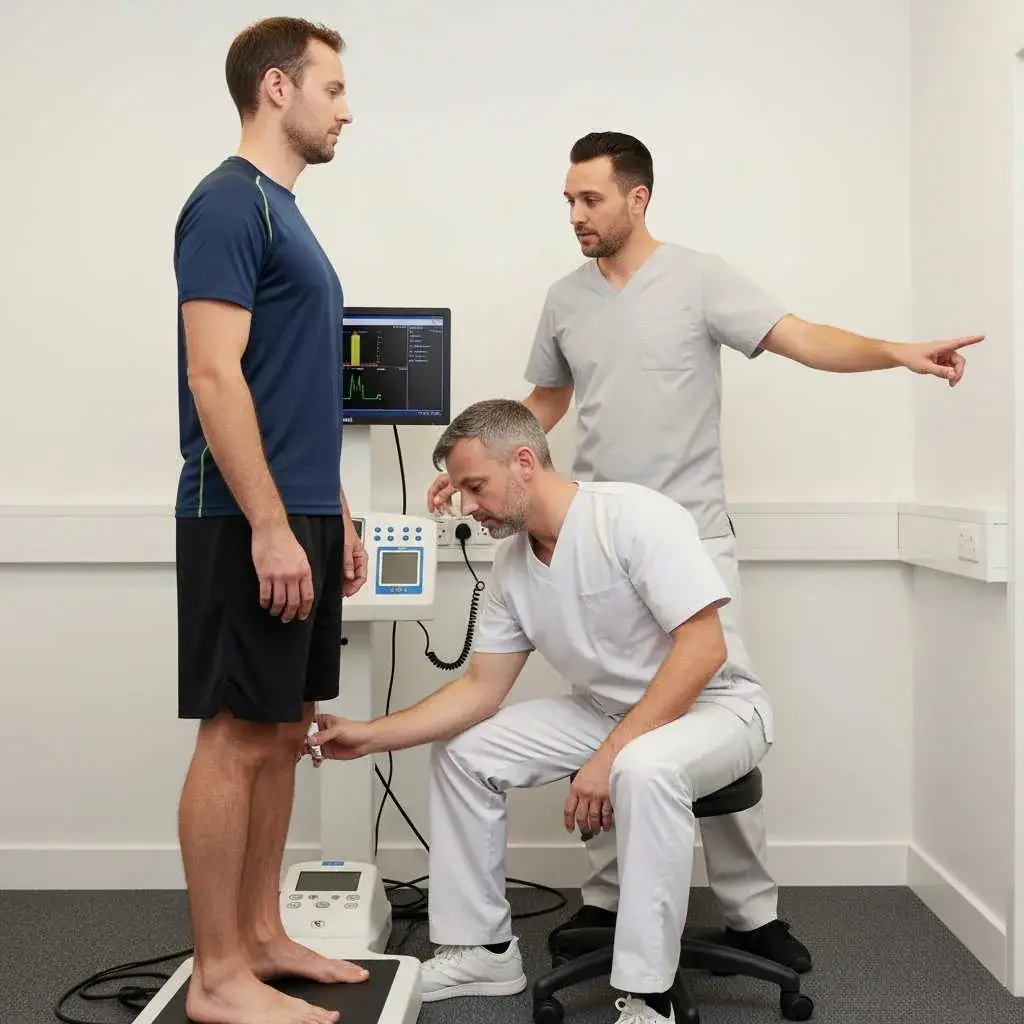
Then, we’ll ask you to stand for the weight-bearing assessment. Here, your podiatrist observes your posture from the ground up – your arch height, heel alignment, knee position, and even checks for things like leg length differences. We’re assessing how your body manages load.
This detailed, systematic check is far more in-depth than a quick glance. Why this level of detail? Because subtle imbalances here can have significant effects elsewhere.
For instance, tight calf muscles can be a major factor in Achilles pain, and limited big toe extension can heavily impact how your foot functions during push-off when running, often linked to plantar fasciitis.
Investing this time in a thorough static check means we’re less likely to miss these crucial clues, unlike quicker, more superficial evaluations.

Consider ‘Sarah,’ a keen runner we helped. She had persistent knee pain despite various treatments.
Her static assessment revealed significant overpronation in one foot – something not obvious until these specific weight-bearing checks. It highlighted how a foot issue can impact the entire kinetic chain.
3. The Dynamic Assessment: Seeing You in Motion (Gait Analysis)
This is often where the full picture emerges. We analyse how you walk and, for active individuals, indepth posture analysis. This is our gait analysis.
We’re not just watching; we’re clinically analysing each phase – from your foot strike to push-off, observing patterns like pronation (foot rolling in), supination (foot rolling out), joint coordination, and any asymmetries.
This dynamic view is vital because many problems only become apparent when your body is in motion. We use AI technology to assess posture, so we can show you exactly what’s happening.
You’ll walk. It’s not a fitness test, but an observation of your biomechanics.
We’ll explain what we’re seeing – perhaps how excessive foot pronation during your run could be overloading your plantar fascia, or how your hip control might be affecting your knee alignment.
You might have seen gait analysis in a running shop, but this is very different. A retail scan is usually about selling a shoe.
Our clinical gait analysis is a diagnostic tool, part of a much bigger picture, focused on your specific pain and getting you back to your sport.
If past advice hasn’t worked, it might be because this dynamic piece was missing or wasn’t interpreted fully. This comprehensive analysis is why a specialist assessment can uncover answers that other approaches might miss.
4. Your Footwear: Allies or Accomplices?
We’ll ask you to bring your commonly worn shoes, especially your running or sports footwear.
We examine them for wear patterns, their suitability for your foot type and activity, and critically, how they might be contributing to your problems. The wrong shoe can significantly worsen a biomechanical issue.
This is a very practical part where you’ll get direct feedback. For example, we might find your ‘supportive’ running shoes are too flexible in the midfoot for your foot type, potentially aggravating your plantar fasciitis.
5. Pulling It All Together: Your Diagnosis and Personalised Plan
At the end of the 60 minutes, your clinician will explain all their findings in clear, straightforward language.
We’ll connect the dots from your history, static tests, movement analysis, and footwear to arrive at a specific diagnosis for your lower limb condition. This is where our team’s 35+ years of collective experience is invaluable.
Based on this precise diagnosis, we’ll discuss a personalised treatment plan. This often involves a ‘package of care’ – a structured programme designed to not just relieve your pain but to address the underlying causes and help you ‘Treat, Move, Improve’.
We’ll explain what that package might entail (e.g., custom orthotics, specific exercises, advanced therapies like Shockwave Therapy or Class 4 Laser therapy, if appropriate) and why each component is recommended for you.
You’ll have ample time to ask questions. Our aim is for you to leave with a full understanding and renewed confidence.
6. What to Expect & How to Prepare
To make the most of your assessment:
- What to Wear: Comfortable, loose-fitting clothing – shorts are ideal- need to expose lower limbs
- What to Bring: Your usual everyday shoes, your sports trainers (especially those used for the activity causing pain), any current insoles or orthotics, and any questions. Previous medical letters or scan reports are also helpful.
- What the Assessment Isn’t: This is a diagnostic process, not a treatment session itself, though it’s the first step to effective treatment. It’s generally not painful, but some movements might highlight sensitive areas. Your comfort is always our priority.
Is This In-Depth Assessment Always Necessary?
While a comprehensive biomechanical assessment is invaluable for persistent or complex issues, we believe in guiding you to the right care. So, who might not need this 60-minute deep dive as their very first port of call?
If you have a very recent, simple, acute injury with a clear cause (like a stubbed toe that’s not improving as expected) or a minor skin/nail issue without underlying mechanical pain (such as a simple corn or verruca needing straightforward attention), a different type of initial consultation, like our Routine Initial Assessment, might be more suitable.
Similarly, if you’re seeking basic foot care without ongoing pain, a routine appointment may be best. Our team can always advise on the best starting point; we want to ensure you invest wisely in your care.
This transparency is central to our patient-centred approach.
Your Next Step: Understanding Leads to Action
So, a Biomechanical / MSK Assessment at We Fix Feet is a thorough, expert-led investigation into your unique structure and movement.
It’s designed to move beyond guesswork and provide the clear, accurate diagnosis you need to finally address that frustrating foot pain, heel pain, or Achilles tendon pain.
Are you tired of treatments that only scratch the surface of your sports injuries or lower limb conditions? Is a clear, comprehensive diagnosis what you feel has been missing in your journey to recovery?
Armed with the understanding from this assessment, you’ll have a clear diagnosis and a tailored plan. This gives you the confidence that you’re taking a significant, positive step towards getting back to your running, your sport, and your active life, pain-free – to ‘Treat, Move, Improve’.
If this sounds like the clarity and expert approach you’ve been looking for, the next step is to book your Biomechanical Assessment. You can do this easily via our online booking system.
Want to understand more about specific conditions often identified? Our guides on Plantar Fasciitis or Achilles Tendon Pain might be helpful.
Ready to Take the Next Step Towards Pain-Free Movement?
At We Fix Feet, our expert podiatrists are dedicated to understanding your unique situation and providing personalised care. We aim to help you treat your pain, improve your movement, and get back to living life to the full.
We’ve helped thousands of people just like you overcome frustrating foot and lower limb conditions.
Your Journey to Recovery Starts Here:
The best way to understand how we can help is to have a conversation. Let’s explore your symptoms and discuss the most effective treatment options for you.
Prefer to talk first? Call us directly on 0115 9328832 to speak with a member of our friendly team.
Want to learn more about our approach first? Discover Our Commitment to You on our About Us page or explore Our Advanced Treatment Options.